
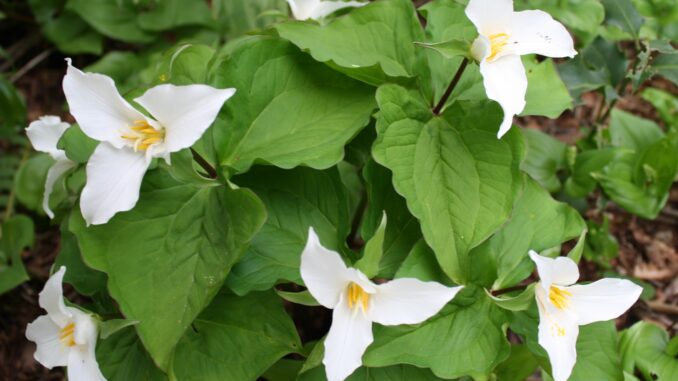
I love the Pacific Northwest native flora this time of year as they emerge from our long dark winter. Since we can’t get out into the woods everyday, we have brought the woodlands colors home forming our mostly PNW native plant garden some of which is shown below.
Native Berries of the PNW
Salmonberry (Rubus spectabilis) plants have long leggy branches with attractive blossoms that morph into edible berries. The berries ripen from early May to late July in most of the Pacific Northwest (later at higher elevations), and resemble a large shiny yellow to orange-red raspberry. These and other native berries have been a staple of Northwest Indians and as the name implies, they are the color of salmon and are eaten with salmon.

Salmon berry bush and a close up of a blossom from our garden. Note the bumble bee hovering in a holding pattern waiting to dive into the blossom.
Osoberry (Oemleria cerasiformis) fruits are favorites of birds and bears of the PNW. AKA Indian Plum as they were/are used by the local Native Americas. Early Spanish explorers named it Osoberry when they first saw bears eating them. The fruits are small plum-like and not sweet although edible in a pinch. Osoberry is one of the first to flower, often in February and provides a nectar source for hummingbirds and pollinating insects.


Osoberry blossoms and a couple of green berries that just popped yesterday.
Snow Berry, (Oemleria cerasiformis) is another native shrub that produces edible berries for animals (birds) but are toxic to humans. Snow berry is a prolific, widespread understory shrub in our vast conifer forests. Currently it is not in bloom and its berries must wait until late fall or winter, after which they linger on the plant into spring and summer. Here is one lingering with some of its berries still intact.
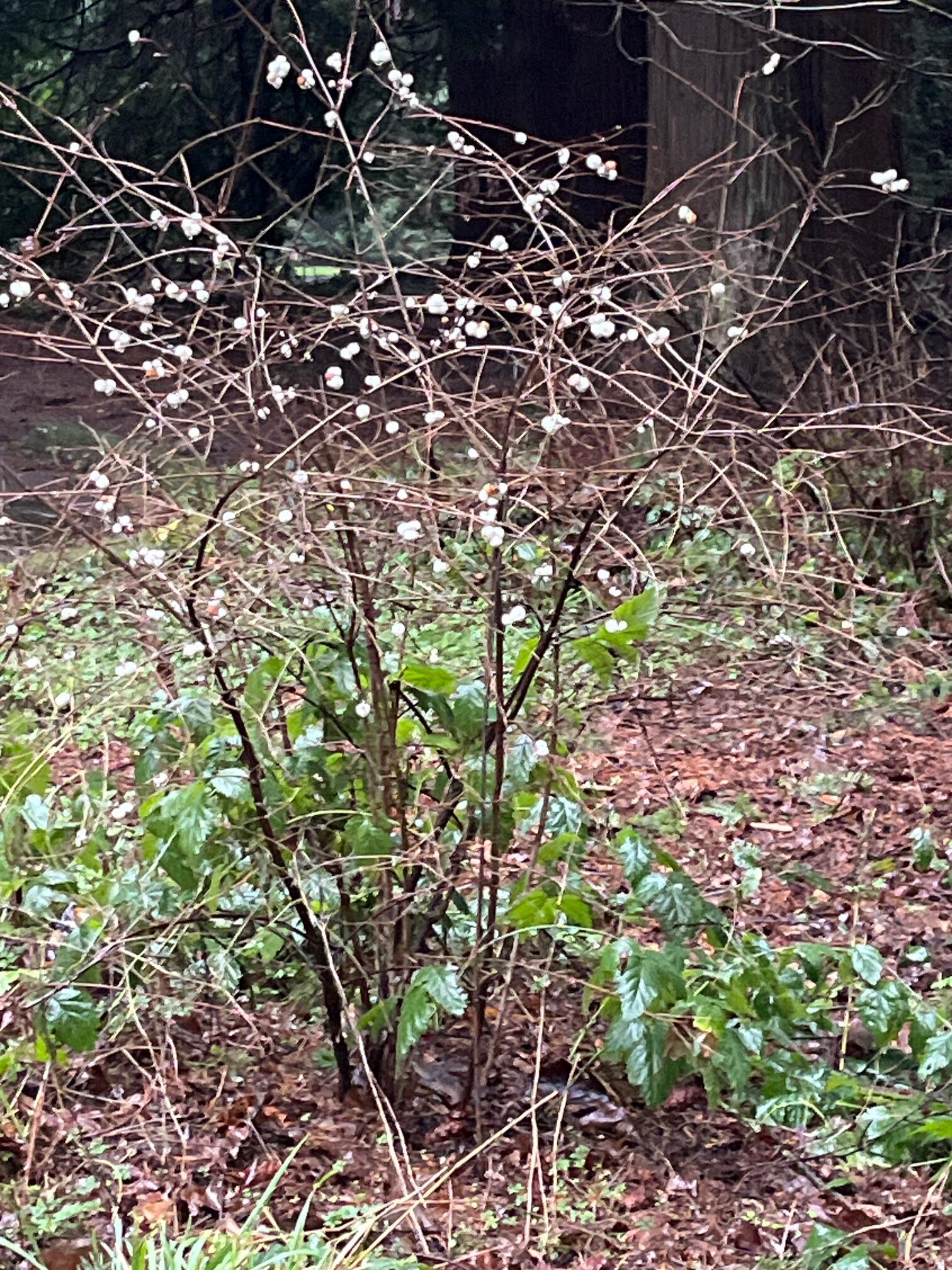

The berries shown here were used for a small winter arrangement made of lichen, ferns, and snowberries from the local woods.
Red Elderberry (Sambucus racemosa) is a large shrub that can grow to tree size of 24 feet. They produce a small red berry that can be edible if the seeds are removed as they are toxic. Historically and currently they are used as medicinals for stomach pains and skin rashes.

The elderberry leaves and especially the blossoms are very attractive
Mahonia, or as it is known around here: Oregon Grape. There are several species here: one is called Tall Mahonia (M. Aquiliform) and a shorter one, (M. nervosa). Late in the summer it produces purple, grape-like fruits that are quite edible. They were very popular with the locals Indians and I had a colleague who made wine from them. In its flowering phase, humming birds and various pollinators love it.

Note that Mahonia’s leaves are sharply pointed around the edges, very much like English Holly. Its full headed blossoms are gorgeously yellow. (from our garden)
Red flowering current (Rubis sanguinus) is also native to the woods of Western North America. Its berries are edible although tart. The berries are often used in jellies while the blossoms are used in drinks and in salads for color.

Salal, (Gaultheria shallon), also native to the PNW woodlands covers the ground nearly everywhere around here. It grows 1 to 5 feet typically and its lovely blossoms shown below produce dark blue berries that are loved by most forest animals, particularly the local deer that forage through our yard.
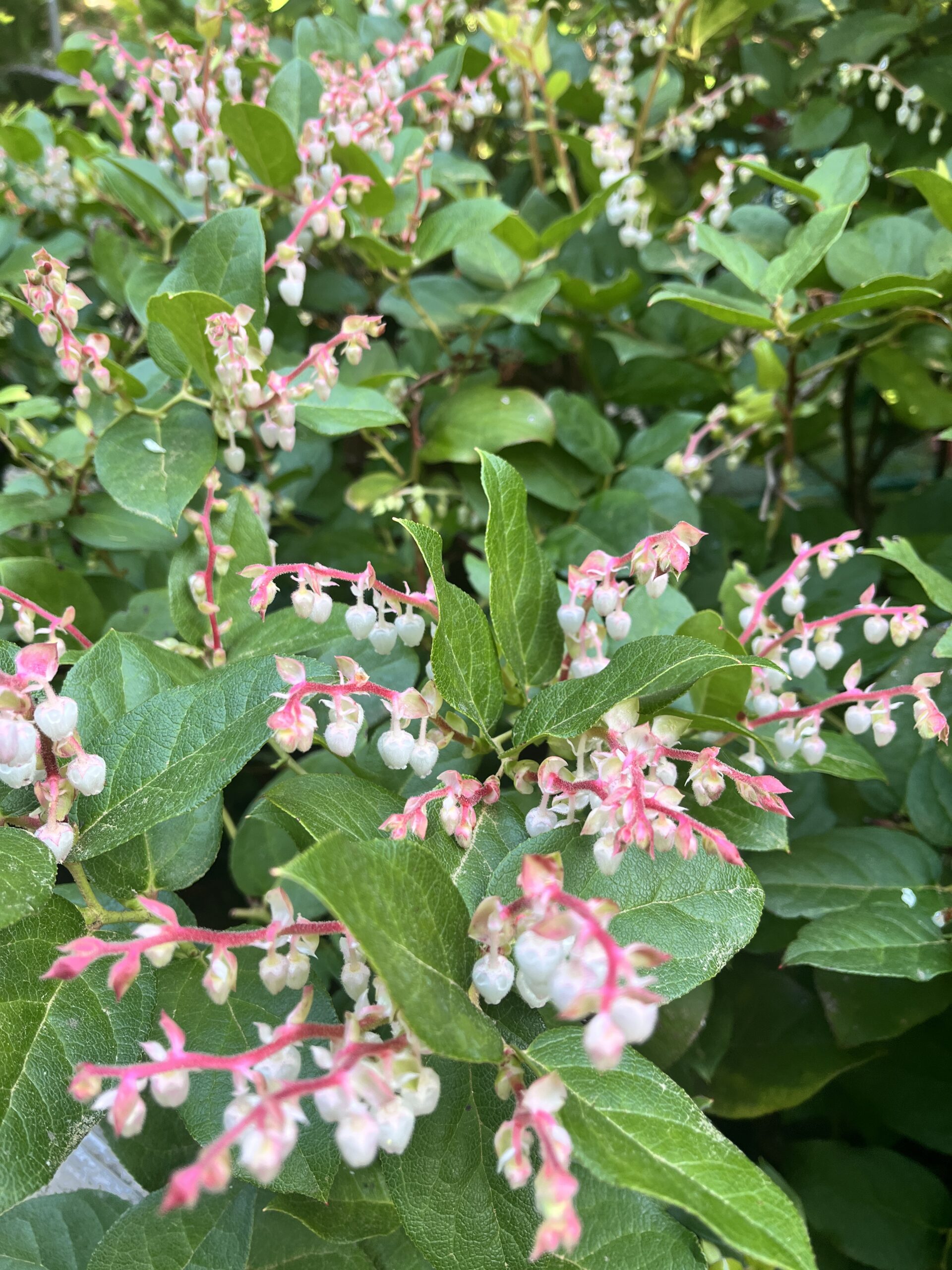

Salal shrub in our garden with a blossom about to open up and above are the blossoms fully opened.
Assorted other colorful harbingers of spring:
Western Skunk Cabbage, (Lysichiton americanus), also called Swamp Lantern, grows in wetlands and swamps with water present. Its name derives from the unpleasant but distinctive odor it emits when it blooms in the spring.

Above is a single specimen up close in a wetland .
Wild Bleeding Heart (Dicentra eximia) is a long-blooming perennial found throughout our woodlands, blooming in the spring and continuing well into the summer. It is a lovely ground cover in the woods.
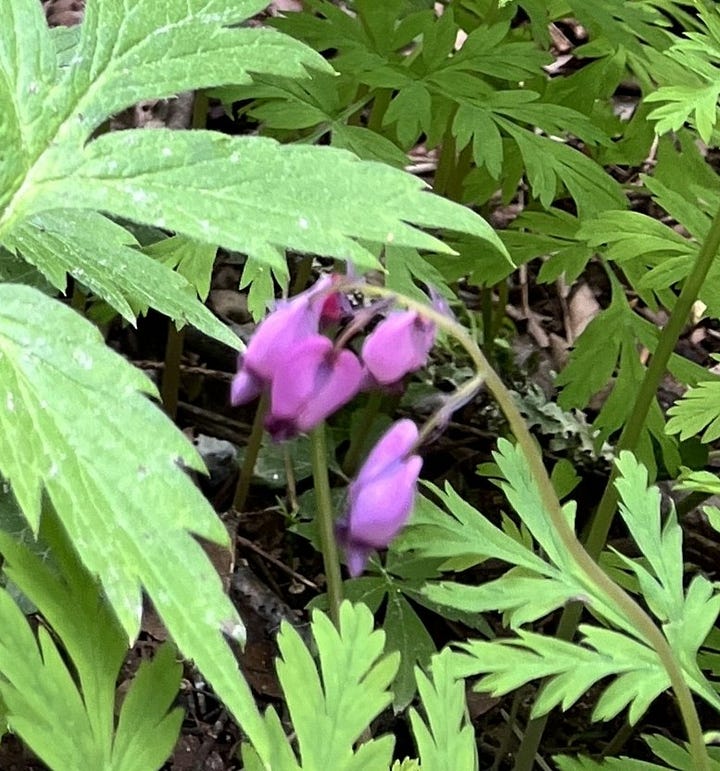
This spray is from a large patch in Arroyo Canyon Park and a close up of its pretty heart shaped blossoms.
Ferns: Up and down the west coast of North America, if there is a groundcover in our coniferous forests, it is fern. There are about 40 species of ferns in the PNW. They are everywhere, often up to your chest and sprawling. I just counted 21 sword ferns in our yard, and that is not counting the many other species.


Western Sword Fern (Polystichum munitum) is thick in the woods here. In the spring it pops up new growth called fiddle heads on their way to becoming full fledged ferns.
A native forest Garden.
Below is an array of several of the plants shown above, intermingled as they appear naturally in the woods, just outside of town. Here, they are set amidst moss-covered trees in the background.

What one sees on a spring walk in the PNW woods: bleeding heart, sword fern, Mahonia, Oso berry stems, moss covered trees
A view of our front yard with four native Northwest plants against the house: Mahonia, Sword Fern, Oso Berry, and a Western Hemlock conifer.
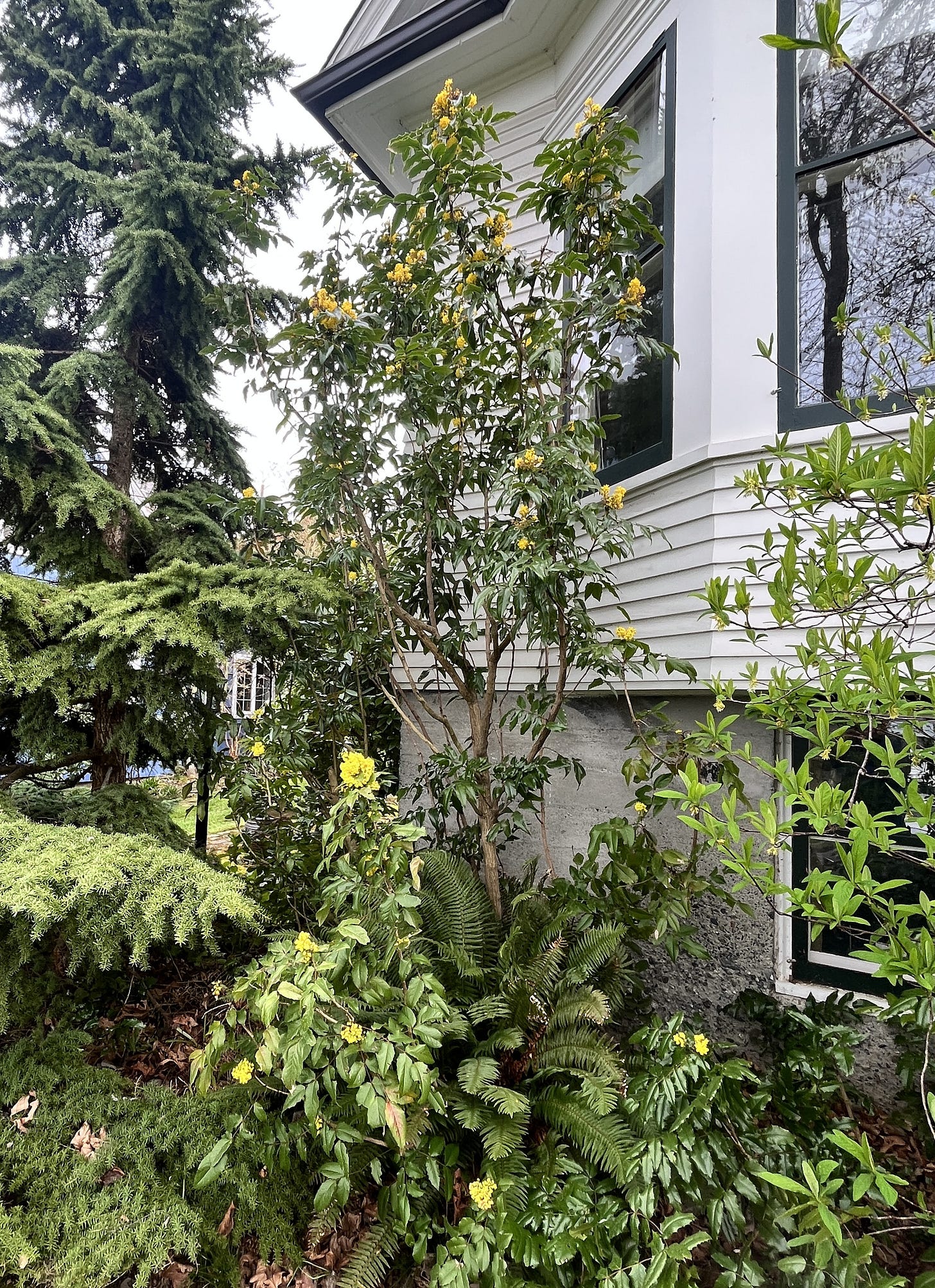
What you see on approaching our house in the spring.
{{{RonK}}} Lovely. Thank you for bringing your spring time to us.
Hi Bfitz,
I am pleased that you enjoyed a bit of our northwest spring. Right now we are being deluged with pouring rain which will bring out the next round of colors. We hope all is well in AR.
I always enjoy your nature diaries. Glad you’ve got another round of color coming. We didn’t get a lot of flowers this year. On the edge of drought but mostly that we’ve had a bunch of warm spells that encouraged flowers to start blooming interspersed with hard frosts that killed them before they could actually do it. But I’ve got a rose “bush” that’s the stock a hybrid was grafted onto – it froze below the graft line 3 years ago – that has bloomed like crazy this year. Not much scent and “simple” flowers but a beautiful red. So that was a lovely gift of color this year.
Thank you Ron, it’s nice to see the garden from the perspective of your camera lens. I would like to replant the trillium that’s gone missing and find more native ground covers this year.
Beautiful! Thank you for sharing!!
Thanks, JanF. My pleasure.